Posts on the Andean Cosmovision

Tag: Americo Yabar (Page 8 of 9)

Remember to Wave Your Warak’as

In this post we continue to pursue an understanding of how the complementarity of opposites informs the Andean people’s understanding of themselves, their relationships with each other, and their relationships with the Cosmos. In earlier posts we looked at the basic concepts underlying the complementarity of opposites (Yin/Yang of the Andes), how it informs the relationships between women and men (Wharmi-Qhari), and how the ritual encounter (‘tinkuy’) of differing energies can give rise to new life force (Tinkuy: Confirming the Rules of Life).

In that latter post tinkuy was introduced within the context of ritual battles that up until recent times were waged between neighboring communities in the Andes, and in the whipping dances that continue through today. In this post I would like to take a look at tinkuy in the form of competition between communities and between individuals, and then use that as a foundation to understand don Americo Yabar’s description of the three levels of relationship between people in the Andes.

The true treasure of the Andean Cosmovision is found in the ways that it differs from the view of reality offered by my modern, western, culture. This difference is deeper than simply having a different set of beliefs, or a different set of meditative practices, and this is exactly what is lost if we skim off a few beliefs and meditations from the Andean culture and toss them into our eclectic bag of ways for working with the energy of Nature. The change I believe we need as a culture if we wish to head toward a future of greater beauty and health, not only for us but for the whole planet (our future cannot be beautiful or healthy without accomplishing that for all of Nature as well) involves deep and fundamental changes in the way we experience reality, and in our relationships with each other, in our relationships with the Cosmos, and with the various aspects of our own Being.

The Festival of Qoyllu Rit’i

We have seen the role of tinkuy in the ritual battles and whipping dances of the festival of Pukllay (earlier post), now I’d like to turn to the expression of tinkuy in the dance and band competitions found in the Andean festival of Qoyllu Rit’i (held in May/June of each year). Qoyllu Rit’i is a time when communities of the region come together on the slopes of the majestic Apu Ausangate range. Communities bring their own bands and dance groups to compete during the festival. The battle of the bands is somewhat like a real battle in that the various bands don’t just take turns playing their best but at times try to drown each other out with their music. The competing dance groups have worked long and hard during the preceding year on their costumes and on their dances in the hope of outperforming both in style and energy the other groups. These band and dance competitions are tinkuy, an encounter of differences leading to a union that is greater than the sum of its parts.

“It may seem paradoxical that competition enters so strongly into an event that serves to integrate ayllus (communities defined by relationships) over a large region, and whose overall effect is to produce an overwhelming sense of ‘comunitas,’ an ecstatic submersion of individual selfhood into a larger whole. Yet it is exactly the competition–the clash of ayllu with ayllu, province with province, puna (high grasslands) people with valley people–that explodes in a huge jingle of sound and blaze of color, in an intensity of activity and noise, which vibrates for a few days in the sun and ice of the Apu’s glacial solitude.” (Allan, pg 176).

View of Asungate Range

Ausangate Range

Paucartambo

My own experience of a regional dance competition was at a festival in the town of Paucartambo, which don Americo Yabar had taken me to see. It was a festival that is not well-known by outsiders and I was about the only non-Andean there (it was one of those ‘pinch me I must be dreaming’ moments). Some of the dance groups had walked over 15 miles through the mountains to represent their village in the competition. The photos below are of the dancers from the village of Mollamarka.

Dancers of Mollamarka
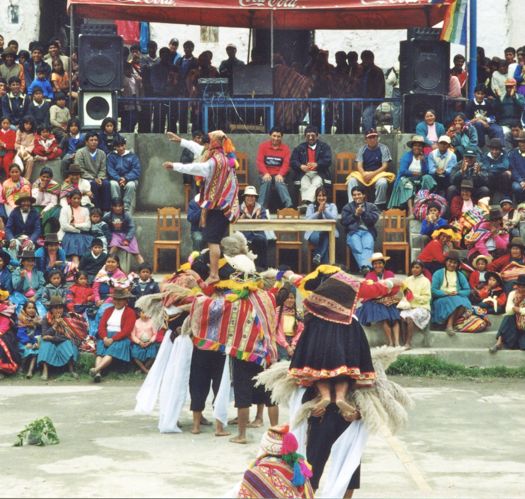
Dancers of Mollamarka

Dancers of Mollamarka

Earning Smiles and Applause

The Day of the Horse

Dance and band competitions are tinkuy between communities. Competitions in the Andes can also be between individuals. In her book Rituals of Respect the anthropologist Inge Bolin describes a horse race that plays the title role in a sacred festival held in the high Andes, a festival the locals call ‘The Day of the Horse’.

The festival is held to honor (in ayni for) ‘Illapa’, the Andean deity of thunder and lightning. As a reminder (from earlier posts), the Quechua language has no word that translates without distortion into our word ‘god’. The Andean gods are not transcendent spirits, they are, instead, the consciousness inherent in that aspect of Nature or the Cosmos.

The honoring of Illapa plays an increasingly important role in the culture as one moves higher up in the Andes. In the high villages death of both people and their animals by lightning is a recurring threat. The thundering sound of the horse’s hooves during the race and the celebrations surrounding the event honor and appease Illapa.

The race is held in a high mountain valley with the massive range of Ausangate towering over its far end. The track is about two kilometers long, at its end the riders need to negotiate a steep mountain side before returning. Women, children, and men not in the race sit on the surrounding slopes to get a vantage point from which they can cheer and applaud the riders. The race is held in heats of four which take all day to complete. By the time the last, championship, heat is held it is dusk, and the riders disappear into the gloom of night to emerge again from the darkness as they come charging back.

Inge Bolin notes that the riders, who are called the ‘Sons of the Thunder’ are enthusiastic and every contestant hopes to win. And yet, while they are racing, they often sacrifice speed to sit up and swing their warak’a (slings) above their heads and jubilantly shout out the names of important sacred sites and spirits.  ‘Every contestant hopes to win.  Yet, it is more important to participate, to celebrate this day, to remember the gods, to be together in joy and harmony.”  (Bolin, pg 173).

In the evening, when the race was over, Inge realized that she hadn’t heard who had won. She asked the people around her but they just smiled. Finally, someone pointed out the winner.  “I congratulate him for having won this thrilling race. He smiles and shyly averts his eyes. Only later do I full comprehend that winning is not the prime reason for staging the race, and I realize that it was not proper behavior to ask for the winner or to congratulate him openly. In an egalitarian society where respect for others is a primary concern, it is not considered polite to make much fuss about one person, stressing his individual achievement to the detriment of others. The race was a success…The gods were pleased…It was a great competition in which the riders competed with and not against each other. Everyone who witnessed or participated in this energetic ritual was equally important.” (Bolin, pp 173-174).

As I read the phrase ‘competed with and not against each other’ something arose in my mind, something I remember don Americo Yabar talking about years ago that had not made sense to me at the time. Now I think I have a better understanding of it.

The Three Stages of Relationship

Americo was describing three stages that can occur in a relationship. The first stage of a relationship he called ‘tinkuy’, and he uses the term a bit more narrowly than Bolin and Allen.  Tinkuy is the encounter of two different energies (e.g. two different people).  This happens when the sphere of energy around one person first comes into contact with the sphere of energy around another. At this point one can begin to sense in which ways you are similar and in which ways you differ from the other person.

The second stage in the relationship Americo calls ‘tupay’, which he described as involving a competition between the two people. At this point in the explanation, in my notes, Americo hesitates and tries to explain the nature of this competition, that it is not the western, aggressive form of competition where a victor stands in triumph over the loser. I could never quite grasp what he was getting at until I read Bolin’s account of ‘The Day of the Horse’, a jubilant race where you compete with the others rather than against them. The point of the competition in ‘tupay’ is not to triumph over your competitor, but to discover in which areas each of you excels over the other.

For the relationship to then reach its deepest level, the third and final stage is to move from ‘tupay’ into ‘taqe’. In ‘taqe’–now that you have found what each one of you is better at–you bring the other person up to your level of expertise in that area. You become equal by both of you becoming more than you were before.

These three stages are described by Joan Wilcox (from her studies with Americo and others) in the book Masters of the Living Energy: The Mystical World of the Q’ero of Peru (pp 58-62). She goes on to explain how this process informs the living tradition of the Andean Cosmovision. The people in the Andes who are the maestros of the Andean Cosmovision are called paqos (also spelled paq’o).  They differ in their ability levels, in what they can accomplish in dancing with the living energy of the Cosmos. Their abilities are not, however, measured by their adherence to a set of specific, traditional, teachings or techniques. The abilities are, instead, the product of their relationships with other paqos, who all have their own set of knowledge and skills. And through the process of tinkuy, tupay, and then taqe these skills are shared with others. As you grow in skill from these relationships you are more able to learn higher skills from others, and you will be more in a position of being able to share something they would benefit knowing how to to do as well.

I would like to expand our view a bit and look at all of the parties involved in these relationships. The abilities of the paqos concern their relationships with the vast, beautiful, sometimes frightening, mysterious, unfathomable multitude of beings (consciousnesses) of Nature and the Cosmos. The ability of interacting, for example, with an Apu (a being who is a majestic mountain peak) is not just a skill, it is a relationship between two beings, the Apu and the paqo. Learning from another paqo how to open the door to that relationship is one step, what happens after that is up to the paqo and the Apu. The skills of the paqos, thus, are not just based upon what the paqos have learned to do, they are also the result of their subsequent relationship with Nature and the Cosmos.

Summary

In looking over the past few posts this is what I see. There are at least three patterns of healthy relationships in the Andes.

1) When two differing energies/beings (complementary opposites) come together they can retain and honor their differences, yet form a union, and this is called ‘yanantin’, the harmonious bringing together of complementary opposites, which leads to a whole that is greater than the sum of the parts. From this union of complementary opposites new life force emerges from the synergy of the complementary energies dancing together. A harmonious interaction of female and male energies is an example of yanantin.

2) When two similar energies/beings come together this is called ‘masintin’. I do not know if the alliance of two similar energies also produces a whole that is greater than the sum of the parts, or if it creates a whole that is equal to the sum of the parts. I suspect it is the latter but none the less beautiful for that. In our lives we have the opportunity to form many yanantin and many masintin relationships.

3) A third option is one that might be called co-evolution, where we start off by noting our differences, specifically differences in our abilities, and then we endeavor to pull each other up to our best levels. What starts off as difference ends up as equality, not by finding a mean but by mutual elevation. This, as I see it, is the path of the paqos.


Share... Facebooktwitterredditpinterestlinkedinmail

Giving Flowers to the Cosmos

An important part of my journey on this path is to regularly give despachos (offerings) to the Pachamama (the great Being who is the planet Earth), to the Apus (the Beings who are the majestic mountain peaks), and to the creek who flows so beautifully past where I like to meditate. Despachos are offerings made to nourish our relationship with Nature and the Cosmos. In the Andean Cosmovision it is possible to form a relationship of respect and  love with Nature and the Cosmos, for the Andean people live in a physical world that is as conscious of them as they are of it (see the post Barefoot in the Mountains).

Despachos can be very simple or very elaborate. The despachos I have seen the Q’ero (also spelled ‘Qero’) make are both elaborate and beautiful, with each element carrying important significance. The intent of a despacho can be to express gratitude and nourish the relationship with the facet of the Cosmos to whom the despacho is offered, or it can be to express some specific desired outcome. In this post I would like to share how to make simple despachos of gratitude.

Joan Wilcox in her informative book Masters of the Living Energy: The Mystical World of the Q’ero of Peru draws a distinction between ‘despachos’ (made for specific outcomes) and ‘pagos’ (simple expressions of gratitude). I have not heard don Americo Yabar draw that distinction. Both terms are Spanish in origin, and when I turn to my English-Spanish dictionary to see if it can clarify the meaning of the terms I am led to wonder how either  every came to be associated with the offerings made in the Andes. Perhaps the dictionary doesn’t tap a subtle use of the terms that would indeed fit the despachos of the Andean people.

I use the term ‘despacho’ for any offering made to Nature or the Cosmos in the spirit of ayni, no matter how simple or complex, including those made just to express gratitude. As I write this my mind wanders back to a workshop by don Americo that I attended in Hawaii. We made a group despacho, consisting simply of flowers that we all brought to lay upon the Pachamama (in this case the verdant slope of a volcano).  After the despacho was complete a hole opened in the cloud cover and a shaft of sunlight slanted down to illuminate just the flowers. It was a beautiful experience.

Simple despachos of gratitude have become an essential part of my Andean meditative practice. This began one time when I was teaching some of the Andean meditations to friends. We were sitting out in the woods. We started with the Touching the Pachamama meditation and then moved on to the Releasing Hucha meditation. When it was over I was overcome by a deep sense of appreciation of living in a conscious Cosmos where the Pachamama will accept our hucha from us, where the Cosmos will send down refined energy to replace the hucha, and where all the facets of Nature and the Cosmos are available to help support our personal and interpersonal transformations in a relationship of mutual respect and love.

Up to that point my despachos had been mainly rather formal rituals I went through out of a sense of obligation. But all  changed in that moment. Since then I always bring some tequila with me when I go into the canyons to meditate. After clearing my hucha I pour a little tequila onto the Pachamama with the intent (sincere pretending) that it carry my gratitude to her, if I am sitting next to the creek I give a little to the creek with the same intent, and I throw a little tequila into the sky for the Apus. This–the simplest of despachos–is my heart-felt way of connecting to these facets of Nature. Despachos are not the material components of some spell to control nature, they are not bribes nor payment for services rendered, they are like giving flowers to a loved one, they nourish the relationship. And as I write this it occurs to me that gratitude is indeed an interesting thing, it is something that cannot be faked.

Sometimes I want to offer a more elaborate despacho, and this takes a little bit of preparation. I base these despachos on a few of the elements I have seen go into the elaborate Q’ero despachos. For a despacho to the Pachamama I bring three red flowers and three white flowers. Red and white flowers are an important part of Andean despachos. Red flowers represent blood, the Pachamama, the feminine. White flowers represent the masculine energy and the Apus (most but not all of whom are male), white  also represents the stars. I also bring three sugar cubes. Once when I was in Peru, and a Q’ero woman was explaining the significance of the various elements she was adding to her despacho for the Pachamama, she placed some candy into the despacho and explained that the Pachamama has a sweet tooth. Americo, who was translating for us, winked and joked that this might be a projection. Still, candy or sweets are a nice touch for a despacho to the Pachamama.

To complete a despacho for the Pachamama I dig a small hole into the earth. In the Andes the despacho would be wrapped in a large sheet of paper and tied with a string before burying, but I skip the paper for Western, ecological, reasons. I hold the flowers up to my mouth and gently blow on them three times, with the intent of imbuing them with the very finest of my energy. I then gently place the sugar cubes and the flowers into the hole, and pour a little tequila on them while holding the intent of expressing my gratitude to the Pachamama for all that she gives us. Finally, I fill in the dirt on top of the despacho and gently press it down with my hands.

For the creek that flows past my meditation spot I bring three red and three white flowers, gently blow on them three times to imbue them with the very finest of my energy, and then I cast the flowers into the flowing water, and follow that with a little tequila, again with the intent of expressing my gratitude to my brother the creek, for his beauty and for what he brings to me as he flows through my life.

For the Apus, I use the same elements as I do for a despacho for the Pachamama, but I bundle them into a piece of paper, tied with a string, that I then place in a fire. As I rarely make a fire I don’t make this despacho very often.

OK, that’s it, that is what I do. Ayni. Very simple. If you would like further information on making despachos I would like to refer you to Joan Wilcox’s book. I may write further about despachos in this blog.

I have made the point repeatedly in these posts, particularly when discussing some meditation or another, that I believe the essence of the Andean approach is our relationship with Nature and the Cosmos. The various beneficial results of the meditations, including personal and interpersonal transformations, are but byproducts of the beauty and actualization of this relationship. It is a relationship that is not even seen as possible in the assumptions of Western culture. But we don’t have the only set of assumptions on this planet.

For the past summer I have meditated a lot outdoors, and I have gotten a lot from the meditations, and I’ve given many despachos, and it is all ayni, all reciprocity, given with respect and love. I’ve changed, my experience of reality has changed, the reality around me has changed, all in subtle ways, but enough for my heart to sing a soft melody.

Share... Facebooktwitterredditpinterestlinkedinmail

Shedding Hucha

‘Hucha’ is heavy, discordant, chaotic energy. If you haven’t yet, I recommend that you read the earlier post dedicated to hucha. For me the prototypical example of hucha is how I feel when I come home from a bad day at the office. Unfortunately, not only does it sour my experience of reality, I can see the effect on my family when I arrive home full of hucha. There is a beautiful scene in one of the Commissario Brunetti books (by Donna Leon). Brunetti arrives home after a day when something terrible has happened at work (he is a police commissioner). He comes in the front door and his daughter greets him from the other end of the hallway with a happy ‘Hello pappa!’ He greets her back with the happiest voice he can manage, and turns to put his coat away so she can’t see the expression on his face. He hears her say “Mamma, something horrible has happened to pappa!”. The people I love pick up on my hucha even when I am trying to put it behind me when I arrive at home. My wife seems to notice it right away. My sons, when they were younger, would soon begin to bicker and fight.

This is a quick way to shed hucha before entering the house. Quick is not necessary a virtue, but it does make it easy to routinely do this after getting out of the car and before entering the house from the garage. As we will see in future posts, this is also a good way to get rid of your own hucha before working with other people’s energy.

While standing raise both your arms above your head with the palms of your hands facing the sky. With intent (sincere pretending) connect to the energy of the Cosmos with your right hand and let that energy flow into the right side of your body. When you feel that your right side has filled up with this energy, and still keeping your arms raised, bring your two palms together and with intent let the energy flow through your right hand into your left hand and down your left arm into the left side of your body and from there into your heart (munay), where you transform the energy into love.  This is simply accomplished with intent.

Now, bring your hands slowly down over your body, from your head down to your toes, with the intent of gathering up all of your hucha with your hands. When you finish at your feet put your palms down on the Pachamama (the great Being who is the planet Earth) and ask her to take all of the hucha from your hands. One of the great gifts of the Pachamama is to take our hucha and recycle it into refined energy.  This is basic paqo work.

Do this process just slowly enough to maintain the intent of what you are doing. If you do it too quickly it can become a mechanical process without intent and will lose its quality. Still, this is something that doesn’t take very much time and it can easily be tacked onto your arrival at home.

As always, remember, this is not just a way to get rid of hucha, it is a dance step in your relationship with the Pachamama, a relationship guided by ayni (reciprocity). In love she has taken your hucha, remember to at least express to her your gratitude, and next time you are having a drink perhaps pour a little first onto the Pachamama in thanks. A fundamental aspect of the Andean Cosmovision is the balance of giving and receiving. The full expression of the Andean approach is a life where that balance is maintained not out of a sense of obligation but out of love and mutual respect and gratitude. It is a relationship from which special and beautiful things can arise. The larger content of this meditation, then, is our relationship with the Cosmos. As I crank out future posts I will be sharing more ways for living a life of balance with the Cosmos, especially through ‘despachos’.

Source of this meditation: don Americo Yabar.

Share... Facebooktwitterredditpinterestlinkedinmail

Pacha and the Three Worlds

This post will serve as a lead-in to one of my favorite meditations from the Andes. It is another meditation that I have learned from don Americo Yabar. The meditation involves connecting with the three levels of existence, the ‘Three Worlds’, of the Andean Cosmovision. They are the ‘uju pacha’ (the ‘lower world’), the ‘kay pacha’ (the ‘surface world’) and the ‘janaq pacha’ (the ‘upper world’). I have given these Quechua words the spelling they would have if written in Spanish. Phonetically in English they would roughly be ‘ukhu pacha’, ‘kie pacha’, and ‘hanak pacha’.

Like all of the meditations I have shared, this meditation is quite simple. As I began exploring it, however, I found that I wanted to have a better understanding of what the meditation was all about. In searching my notes I found only the briefest descriptions from Americo concerning the uju pacha, kay pacha, and janaq pacha. I decided to turn to what literature is available on the Andean Cosmovision to see if I could flesh out my understanding of these terms. What I found has helped me to hone my intent with the meditations, and I have really enjoyed the results. I would like to share with you what I have found (but keep in mind the fallacies I posted earlier).

The three worlds of uju pacha, kay pacha, and janaq pacha are so fundamental to the Andean Cosmovision that there is actually a fair amount of information available concerning how the Andean people interpret these terms. These interpretations, however, vary widely across the sources I have found.

Part of the breadth of meaning of the three terms comes from the 500 years of Christian influence on the Andean culture. It takes no great conceptual leap to link the uju pacha (the lower world) with the Christian concept of hell, and the janaq pacha (the upper world) with the Christian concept of heaven, and this has changed the meaning of the terms in the post-conquest culture. Even the Q’ero, the people with whom I have worked and who are viewed by many as being among the purer ‘keepers of the flame’ of the indigenous Andean Cosmovision readily identify themselves as being Christian (see Wilcox, 2004). What they exactly mean by this is hard to say. It brings to mind my hearing the women in Mollamarka, Peru sing about Apu Jesucristo (loosely translated as ‘Jesus the Sacred Mountain’).

If we look at the conceptualization of the three worlds which predates the Christian conquest of the Andes then a very different understanding emerges. Even then, however, there are still some differences among sources concerning how these terms are to be interpreted. When faced with a multitude of interpretations of the nature of the uju pacha, kay pacha, and janaq pacha, what did I do? I picked the one I liked, the one that fit my understanding of the Andean Cosmovision, and ultimately the one that enhanced the power of the meditation.

The following description of the nature of the uju pacha, kay pacha, and janaq pachca is based upon a chapter entitled ‘Andean Cosmology and Cosmography in the North-Peruvian Shamanic Mesa’, written by Mario Polia, in the book Mesas & Cosmologies in the Central Andes, edited by Douglas Sharon (2006). An understanding of these three terms depends upon an understanding of the word ‘pacha’.

The Quechua word ‘pacha’ does not correspond directly to any term or concept we have in the West. It is, instead, a bringing together of three of our concepts, an integration of place, time, and consciousness. One facet of ‘pacha’ encompasses the concept of space/earth/world/place. We have already in this blog run across Pachamama as the great Being who is the planet Earth. A second facet of ‘pacha’ involves time/era/period. The term ‘tarpui pacha’, for example, is the time for the sowing of seeds. ‘Pacha’ thus encompasses both place/location and time/period, a particular location at a particular time, but there is a third element involved in ‘pacha’, namely consciousness. In the Andean Cosmovision consciousness is an inherent, immanent, aspect of the Cosmos, if we are talking about a time and a place then we are talking about consciousness as well. Now let’s take this idea of ‘pacha’ and develop a useful understanding of the ‘uju pacha’, ‘kay pacha’, and ‘janaq pacha’.

In terms of a world, or location, or place the uju pacha is the lower world, the world below, the interior world, a place associated with the depths of the planet. When the Andean people want to communicate with the uju pacha they may go to a spring or to a crack in the earth’s surface that provides a conduit into the interior of the world. The uju pacha is the deeply interior world, closer to the surface is the ‘urin pacha’, where seeds are planted to take root and grow. The uju pacha also refers to time, in this case it is the past, the distant past (uju pacha) and the recent past (urin pacha). The uju pacha is the time of our ancestors and before. I like to think of the urin pacha, the more recent past, as the time when seeds were planted in our lives that have blossomed into who we were, who we are now and who we are about to become. Connection with the uju pacha is accomplished by connecting to the interior world (e.g. the interior of the planet) and intrinsically tied to that act is the connection with the past, both distant and recent. Consciousness exists outside of all of our mind’s constructs of space and time so whatever consciousness is it is there and then as well.

The kay pacha is the surface world, the world in which we live, and it is also present time, not necessarily this exact moment of Now but the general neighborhood of time around it.

The third world, the janaq pacha, is the superior world, the world above. The near above, the realm of the majestic mountain peaks, is known as the janan pacha. The janaq pacha is the highest zone, the realm of the stars, ‘the seat of archetypal forms of spiritual principle of all living things’ (Polia, pg 35). The janan pacha and janaq pacha also refer to the future, the near and distant future respectively. Connection with the janaq pacha is accomplished by connecting to the sky above, possibly as far as the stars themselves, and this is intrinsically tied to connecting with the future. If connecting with the uju pacha connects us to the seeds that have blossomed into who we were, who we are now, and who we are about to be, connecting with the janaq pacha is a connection to who we are in the future as Beings in harmony with the archetypal forms of the spiritual principle of all living things. And of course, consciousness, which is outside of time and space, is there and then too.

As Beings we are older than the Grand Canyon, but not as old as the stars.  don Americo Yabar.

Next post, a meditation which brings this into blossom.


Share... Facebooktwitterredditpinterestlinkedinmail

On Doing Not Doing

Out beyond ideas…there is a field, I’ll meet you there.
Sufi mystic Jelaluddin Rumi (1207-1273)

I first ran into the concept of ‘not doing’ in the works of Carlos Castaneda. His early books, particularly Journey to Ixtlan and Tales of Power had a big effect on me when I was a young man. Later in my life I ran into ‘not doing’ again when I began working with don Americo Yabar. And more recently, I have run across it, in a most beautiful and pragmatic way, in the book A New Earth by Eckhart Tolle. In the previous post I shared the basic outline of how and where to practice ‘not doing’ as part of the Andean approach for exploring our relationship with Nature and the Cosmos. In this post I would like to express more about what I think ‘not doing’ is all about, and also share some techniques for ‘not doing’ that I have found to be useful.

My awareness is almost always focused upon the products of my mind. The mind is an incredible thing, it takes all of the information reaching the senses and makes ‘sense’ of it all. That we see the world as consisting of separate objects rather than one undifferentiated mishmash of colors is thanks to the mind. Not only does my mind figure out, for example, that the chair I am looking at is an object separate from everything around it, it also places the object into the category of ‘chair’, so that when I look at the chair I don’t see just an ‘it’, I see a ‘chair’. That’s amazing when you think about it, and the mind is doing this all of the time we are awake with everything that we perceive. And that is just the start, not only does the mind identify and label everything reaching our sense organs, it also figures out–of all the millions of things happening around us at any one moment–what are the more important things to pay attention to. The mind also makes judgements about the ‘good’ or ‘bad’ of what is happening, and how it affects our view of ourselves and of the people around us and of the world itself, and so on and so on up to more and more abstract levels. The mind may also wander away from what is happening here and now, to consider instead what has happened in the past or might happen in the future, or what might be happening elsewhere. The workings of the mind are accompanied by an internal dialog, a flow of thoughts that accompanies the process of the mind making sense out of the world. Our normal state of awareness is to simply experience and act on the interpretation of the world that our mind presents to us, this is so much our habitual experience that we mistake the interpretation of reality presented to us by the mind as being reality itself.

To say that our mind is massively useful would be a gross understatement. It is rather helpful when putting on your clothes to know what part of reality is you and what part of reality is not, and when eating to know what is food and what is not, and to know why you need to have a job and how to get there, and how the refrigerator opens, and that you need to look both ways before crossing the road, and so on and so on and so on and…well…everything we need to know to live in this world.

After acknowledging its indispensable utility I’d like to point out that the mind is, like, totally mental (sorry…idiomatic joke). It can only give us its mentally created interpretation of reality, not reality itself. Reality is beyond all the thoughts, concepts, ideas, perceptions and feelings we have about it. We can use words and ideas to point at that, by saying that the essence of reality is ineffable, and that it is vastly more mysterious and wondrous than our minds can possibly encompass. And the same is true of us, we are more mysterious and wondrous than our minds can possibly understand. We are the Beings from which our minds and their thoughts emerge, not the being created by our minds.

Knowing yourself deeply has nothing to do with any ideas, concepts, or beliefs you have about yourself. Knowing yourself deeply involves experiencing yourself at the level of Being.  Eckhart Tolle (paraphrase).

In his book A New Earth, Eckhart Tolle points out that we are not the experience created by our minds (our perceptions, our thoughts, our feelings), we are instead the experiencer, we are consciousness. Consciousness cannot be known, for it is the knower not what is known, and while we cannot ‘know’ consciousness we can become aware of our existence as consciousness itself, we can sense it here and now as our very Presence. When we move our awareness to consciousness itself we experience the world beyond/before/behind the interpretations of the mind. This is the basic dance step of the mystic.

While we cannot understand or talk about that which lies beyond all our mental constructs of reality we can use words as guideposts to help us get there. Carlos Castaneda, Americo Yabar, and Eckhart Tolle are all excellent sources for how to proceed down this path. I have culled a variety of techniques from them that I have found to be useful and I present some of them below. Sometimes one technique seems to work better than others, and on some days when I am doing the not doing meditation I may have to try more than one before my experience starts to shift. And on some days, of course, nothing works. Here are some hints (adapted from Tolle’s book):

*Move your consciousness away from the products of your mind (perceptions, emotions, and thoughts) and be aware of your consciousness itself. Let go of thought, become still and alert, and feel your own presence, become your own consciousness.

*Time is a construct of our mind, outside of the mind there is only eternity, ‘eternity’ defined not as an infinite length of time but as the state of timelessness. One way to ‘not do’ is to enter completely into Now. I played around with this for a while, a few times a day I would ask myself ‘is it still now?’, and then I would notice where my experience went when I checked out whether it was indeed still now. What I found was that for me there is something that is always there in my experience when I check out ‘now’. Now I can sometimes just go directly there…where was I…oh yeah. At times I can just go directly to that experience of now. The mind can only interpret reality within a flow of time, it can’t do its thing in pure now (eternity), but consciousness is still there.

*When my internal dialog has the bit in its teeth and has taken off I find it very difficult to enter the now, and I have found the following steps help me get started. First I pay attention, exquisitely, to my breathing. I can’t do that fully and carry on with my mental internal dialog at the same time. After doing that for a while I pay attention to the living energy of my body, the sensations that are available which inform me that my body is indeed still here and alive, it is kind of a gentle tingling within the body but not really tingling…just check it out to see what I mean. That puts me in the present moment as well, then I go on to fully enter the now as described in the preceding paragraph.

*We can only perceive light because dark also exists. Without darkness we could not see light. We can only hear sounds because silence also exists. Without silence we could not hear sounds. Listen to the ever-present silence that is the background to all sound.

*’Doing’ involves paying attention to the various forms (chairs, people, words) that our mind creates out of reality and also attending to the meaning our mind applies to those forms. Let that go, experience what you experience before your mind has organized the world for you. A way that works for me is to attend to the void out of which the forms arise.

So, how does this all tie into the Andean approach? For me it ties in by being something that I have been encouraged to do by Americo. (Paraphrase) “Just go out in Nature, and ‘not do’, especially ‘not doing’ thinking. If the power permits, that is all you have to do, there is no ‘process’ to do, there are just vibrations, your energy and the energy of Nature and how your energy begins to change when you do this. That’s it. I recommend that you do it a lot.” (personal communication). The challenge, by the way, in quoting Americo is that I almost never write down what he says when he says it. I sometimes write it down later that day, or perhaps the next, and then often I just jot down a cryptic note that I then expand back out at a later time to the best of my understanding.

There is a significance to practicing ‘not doing’ in Nature, in a place of salka. I have found this to be a common thread in many of the sources who have had an influence on my view of reality over the years: don Americo Yabar (of course), and as already mentioned the writings of Carlos Castaneda (Journey to Ixtlan and Tales of Power) and Eckhart Tolle (A New Earth), as well as the writings of Alan Watts (e.g. Man, Woman, and Nature) and the anthropologist Gregory Bateson (e.g. A Sacred Unity). I would like to share with you my distillation of what they have to say about this. I prefer to speak from my own experience but in this area I have not gone far enough down the path, so what I would like to share instead is my understanding of what lies down this path, for it is this understanding that draws me to want to explore it.

Here it is. We as Beings have emerged from the higher order patterns of the conscious Cosmos. The Cosmos can be said to have a greater-than-human ‘intelligence’ if we don’t limit our meaning of ‘intelligence’ by having it only apply to the sort of mental intelligence that arises from the human mind. Just as we Beings have emerged from the higher order patterns of the Cosmos our minds have emerged from within us. The mind, then, is a product of higher order patterns and there is no way that our mind can comprehend the patterns, the processes, from which it emerged. It is not a matter of not being clever enough, it is instead simply impossible for the mind to understand its own origins. It would be like a knife trying to cut its own edge, like trying pull ourselves up by our own bootstraps, like a mirror trying to see itself. The mind cannot possibly know the consciousness from which it arose for consciousness is the knower, and when the knower becomes the known it is no longer the knower. Consciousness retreats exactly as fast as the mind pursues, for it is the pursuer.

Now, the mind knows how to create things, for example, a clock. The process the mind uses to create things is not the same process the Cosmos used to create the mind, for the mind is much more limited than the Cosmos and operates off of different principles. We in the West live in a physical and social world that has been predominantly shaped by the human mind, which is one reason why the mind is so great at helping us get by in our society. Our human created world, however, tends to isolate us from an understanding of the higher order patterns of Nature and the Cosmos.

When we situate ourselves in a place of salka, and shift our consciousness from the content of our minds to the higher order Being who has a mind, i.e. move our awareness to consciousness itself, we experience our connection to Nature and the Cosmos, to the higher order, patterns, consciousness from which we emerge. We become, as Tolle puts it, conscious participants in the unfolding of the higher purpose of consciousness. As Americo puts it (comments in parenthesis are mine), the intelligence of the Cosmos is thinking about the solution for our current situation on this planet (‘thinking’ in the same sense that a flower contemplates blooming) and when the time is right (e.g. it is time to blossom) all we need to do is to be in harmony with the Cosmos. ‘Not doing’ in Nature is a way to do this.

Share... Facebooktwitterredditpinterestlinkedinmail
« Older posts Newer posts »

© 2026 Salka Wind Blog

Theme by Anders NorenUp ↑