All the world’s a stage, and we are merely players. But who is our intended audience, our society, or the vast mystery of the Cosmos? (Paraphrase of don Americo Yabar and William Shakespeare).
Share...


Posts on the Andean Cosmovision
All the world’s a stage, and we are merely players. But who is our intended audience, our society, or the vast mystery of the Cosmos? (Paraphrase of don Americo Yabar and William Shakespeare).
Share...
In the Andes they identify three centers of our being; the yachay, the munay, and the llankay. Each center is located in a different part of the body and each provides a different way of perceiving and understanding reality.
The yachay is located in our head. It is our ability to think, in other words it is the intellect. In our culture, at least in my world of science and academia, logic is viewed as the epitome of thought. In the Andes, however, wisdom as a quality of thought is valued more than logic and intelligence. Wisdom is built upon life experiences, accompanied by an appreciation and understanding of the larger-than-individual and larger-than-humanity systems involved in any action. I would add that wisdom also implies some amount of caring and compassion. Wisdom, it would seem, implies a yachay that acts in accord with the other two centers, which we will turn to next.
The munay is located in our heart. It is the center of love. The ‘love’ associated with the munay, however, is not an emotion. Emotions are tightly connected to our thoughts. How we respond emotionally to an event is largely a product of the meaning we assign to it. But the love of the munay is not an emotion; it has nothing to do with romance or sex or sentimentality, and jealousy does not apply. Our yachay and its ability to analyze (i.e. break things into pieces) gives us the experience of being separate from everything else in the Cosmos. In the Andean Cosmovision the Cosmos is a vast network of interconnected filaments of energy and we, rather than being disconnected things, are part of that network. Through the munay we experience our connection with the rest of the Cosmos. The Cosmos has an underlying frequency, and it is our (beautiful) experience of tuning into that frequency through our munay that gets labelled with the closest available term ‘love’. (This definition of love comes to us from don Americo Yabar).
To experience reality through our munay we need to move our consciousness from our head to the area of our heart, and when we do, we experience a different way of perceiving and understanding the world. It may seem strange to speak of moving our consciousness to our heart (compared to, say, keeping our consciousness in our head and simply being aware of our heart). In my culture it is generally assumed that consciousness is always, must always, be in our head. The best way I have, however, for describing how to experience the munay or the llankay is that all we need to do is to move our consciousness there. I’ll be sharing some meditations for exploring this in later posts .
Now to the llankay. The llankay is located a couple of finger-breadths below our navel and a few inches inside our body. The llankay is the center of our physical being and its ability to come into physical manifestation. It is also described as our ability to work, to use our physical body to alter the world. At the center of the llankay is our ‘not-being’, where we are ‘no-thing’, from which our physical being emerges. The llankay is another location where we can place our consciousness and shift our experience of the Cosmos.
I have found the concept of these three centers (yachay, munay, and llankay) to be helpful in integrating my boy-scientist, Western upbringing (very yachay) with my experiences in Peru (very munay). Science, religion, philosophy are all of the yachay. They are immensely useful…and they cannot possibly understand the munay (and vice versa). The intellect can describe and explain and think about reality all it wants and it still does not overlap with reality as experienced by the munay or by the llankay. The integration of these three centers of being comes from a deeper level of ourselves. For me it was at this deeper level–beyond the distinction of the yachay, munay, and llankay–where the beauty and value of my explorations of munay eventually established a level of credibility that my intellect could acknowledge even if it could not understand.
I’ll be sharing some more thoughts about the yachay, munay, and llankay and providing some meditations related to them in upcoming posts (see below)
July 9, 2011: The following subsequent posts are available: The Three Centers of Being (Part 2), Tuning the Three Centers of Being.
Share...
This is a very simple meditation (like the Bellybutton to the Pachamama meditation) but after years and years of seeking to know more and more I find that I have returned to the simple meditations as the foundation for integrating the Andean Cosmovision into my daily life. This meditation is very useful for coming into harmony and balance within ourselves. I don’t use this meditation to get rid of unwanted energy (e.g. anger, anxiety, stress)–there are other meditations for that–I use it when I have simply become too focussed on only part of who I am. For me this often means that I have gotten way too much into my head. There is a certain way I feel after a long spell of intellectual endeavor; from listening to papers being presented at an academic conference, writing computer programs, teaching (or taking) classes, or attending several meetings on the same day. It is a feeling of being disconnected from the full experience of being alive, which is what this meditation can resolve. This meditation is also beneficial for recovering from other ways we might be imbalanced, for example when we are too caught up in our emotions, or when we are feeling spacey and ungrounded from a mystical or spiritual experience. What this meditation can do is to balance our energy and get us in touch again with all of who we are, bringing the various aspects of ourself into harmony.
Here is the meditation in all of its simplicity. Sit on the ground. Begin by noticing the state of your energy, i.e. notice how it feels to be you right now, take a few seconds to do this. Now place your hands on the Pachamama (our mother Earth) and with intent connect the energy of your body through you hands with the energy of the Pachamama. Ask her to bring your energy into harmony with hers. Notice how your energy shifts as you do this, continue until you feel the shift is complete. Thank the Pachamama. Spend a few seconds being aware of your new state of energy, how you feel being you. That’s it.
Well, that’s it as far as the meditation goes, but there is more about this that I would like to share. I recommend that you do the meditation and then come back to this post to read the rest (if you are interested). It is the experiential aspect of the meditation that is important and I don’t want that to be overshadowed by my now going on to some of my thoughts about it.
————
The Andean Cosmovision cannot be explored intellectually, it is explored by noticing the quality of some energy, doing some meditative-like process, and seeing how that affects the energy. If you experienced a shift in your energy when you did this meditation what does that prove? The answer is that it doesn’t prove anything. It doesn’t prove the Andean Cosmovision is true, it doesn’t prove (blah, blah, blah), it doesn’t prove nada. What it means is that you can notice how your energy is and that you have a way of changing it into something more pleasant, that is shaman work.
The Andean meditations all involve our relationship with Nature and the Cosmos (I see Nature as just the most local aspect of the Cosmos) and the foundation of that relationship is ayni. Ayni is the Andean principle of reciprocity, whenever something is received something is given back in return. This applies to the relationships people have with each other as well as to their relationship with the Cosmos. When done with love and respect this is not a matter of ‘breaking even’ it is an act that leaves both sides enriched and it opens the door to a deeper level of exchange. In this meditation the Pachamama does something wonderful for us, she brings our energy into harmony within ourselves by bringing our energy into harmony with her. To nurture this relationship we can insert into our lives smalls acts of ayni for the Pachamama, giving a little wine to her before we drink by pouring a few drops onto the earth, or laying a few flowers upon her breast (red flowers are traditionally offered to the Pachamama), or digging a small hole and putting the flowers and a few sugar cubes into the hole (the Q’ero women told me that the Pachamama has a sweet tooth…don Americo added with a smile that this might be a projection) then covering it with earth, all with the intent of expressing gratitude. There are also more formal expressions of gratitude that can be made (despachos and pagos) which I will cover in later posts but here I believe that intent is again the most important ingredient.
On the surface these offerings of gratitude seem almost to be a social act but more deeply they are energetic acts. We form a loving, respectful, mutually-supportive, energetic relationship with the Cosmos, this is the heart of the Andean approach, this is paqo work. The ayni takes our meditation–whose goal is to make our energy more harmonious and balanced–and elevates it to being a step in our dance with the Cosmos.
[Added later]. Please see the subsequent post on ayni.
Source of this meditation: don Americo Yabar.
Share...
Intro: This is the first of many meditations I will be sharing on this blog. I call them ‘meditations’ only because I can’t come up with a better term. In speaking of them I often refer to them as ‘meditative-like processes’, but that is a rather awkward label. I have heard don Americo refer to them as ‘passes’, but that term has never made any sense to me. What they are in essence are ways of working with energy (or spirit). If you haven’t yet, I recommend that you read the post Andean Cosmovision: The Basics and perhaps also the post Paqos: Shamans or Mystics.
About Intent: These meditations involve following some pretty unusual instructions, such as “open your energy at the top of your head and let the energy of the Cosmos flow into your body” (part of a meditation I’ll be sharing in a later post). How do you go about doing something like that? The answer is simple, you do it with intent. Now intent is a pretty interesting thing and worth exploring. To start off with think of intent simply as “sincere pretending”. That’s all. You accomplish the various steps of the meditations by sincerely pretending that you are doing them, that is sufficient to open the door to the experience that becomes possible through the meditation.
Process: This is a very simple, very special meditation. It is one of the two meditations about which I’ve heard Americo say that if we were to just do this one meditation on a regular basis it would have a profound effect on our lives. My ears perk up when I hear something like that.
First, I recommend before all of the meditations that you take a moment before you start to notice how you feel, to get a sense for what your energy is like before you begin, so that you can compare it to how you feel after the meditation.
Here is how to do this meditation. Lay on the ground on your stomach and pull up your shirt far enough so that your bellybutton (navel) is in physical contact with the Pachamama (that great Cosmic Being who is our mother the planet Earth). What you do next depends upon whether you want to get rid of some undesirable energy, or bring the Pachamama’s energy into yourself, or both.
If you have some energy you would like to get rid of (e.g. stress, anger, depression, sorrow, anxiety), then, using your intent (sincere pretending) let that energy flow from you and into the Pachamama. Don’t be concerned about giving this energy to her, it is not like pollution, the Pachamama takes this energy and recycles it into purer energy that is then released into the Cosmos. This is one of her great gifts to us. With your intent, open your energy field around your bellybutton and feel this energy flowing out of your body and into the Pachamama. If you sense that some of it is not leaving–perhaps it feels stuck in some particular part of your body–then you can use your stomach muscles to press your bellybutton to the Pachamama with a few gentle pushes, this can help. You can also, with your intent, request that the Pachamama send her energy into you through your bellybutton to gently draw that energy from you. Do this for as long as it takes to feel that the undesirable energy has left you body. Then you are either finished or you can also go on to the next step.
If you would like some energy from the Pachamama (e.g. tranquility, love, ease, harmony) you can use your intent (sincere pretending) to open your energy field at your bellybutton and invite her to send that energy into you. Another option is to invite her to send her energy into you with the simple intent that she bring your energy into harmony with hers. Getting your energy into harmony with that of the Pachamama is a very beneficial thing for you to do, it helps move us out of all of the weird states our interaction with our social/political world can get us into, and it also helps us stay in harmony with the changes the Cosmos is going through. Bringing in her energy can be facilitated by gently drawing in your stomach muscles a few times, as if pulling her energy into you. Continue until you feel complete.
When you are finished with the meditation take a few moments to notice how you feel now, what your energy is like after the meditation. The difference between how you felt before the meditation and how you feel after it is the true ‘meaning’ of the meditation.
That is the process, and–as is typical of the Andean meditations–it is very simple but the effects (particularly when carried out repeatedly over a long time) can be quite beautiful. Connecting our energy with Nature and the Cosmos is what these meditations are all about. This is the realm of salka, our natural undomesticated energy.
Context: The Andean meditations are the outward form of something deeper, a shift in our relationship with the Cosmos. It is within this relationship that the “magic” of the Andean meditations arise, but this is not how we might normally think of magic for it is not a way to manipulate or harness the powers of Nature. It is instead something that arises within a relationship of love and respect. The context of the Andean meditations, where their benefits arise from and what the meditations help nourish, is a loving and mutually supportive relationship with Nature and the Cosmos. The active principle of this relationship is ayni.
About Ayni: Ayni is the Andean principle of reciprocity, a balancing of giving and receiving which reflects the underlying dynamics of the Cosmos. As you engage in this meditation with the Pachamama, well, I can’t imagine that a deep sense of love and gratitude for the Pachamama won’t arise. To follow the Andean path step into and nourish this relationship, balance your relationship with the Pachamama, give something in love to her in return. Quite simply, with intent, express to her your heart-felt gratitude. Occasionally, as a simple form of ayni, pour a few drops of wine or other alcohol onto the Pachamama with the intent that it honor her and nourish her (and thus give some energy back to her). Remember, this is not a bribe or a payment for services rendered, it is instead like giving flowers unbidden to a loved one. We will be covering more formal and elaborate offerings (called despachos) and taking a deeper look at ayni in later posts.
[Added later] Please see the subsequent post on ayni.
Source of the Meditation: Don Americo Yabar (don Américo Yábar).
Share...
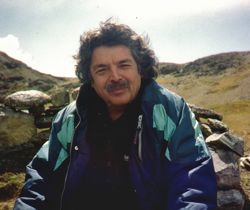
Don Americo Yabar
Don Americo Yabar (don Américo Yábar) is a mystic from the Andes of Peru. Since childhood he has been studying under and working with some of the greatest paqos (mystics/shamans) of the Andes. Having also received a college education in Europe he serves as a chakaruna, a human bridge of energy that connects the energy of the Andes with that of the West.
I first met don Americo in 1994 at a workshop in the deserts of Southern Utah. I subsequently went to several more of his workshops and then began to travel to Peru to study with him there. While I have been in Peru he has also arranged for me to work with other paqos and healers of the area, and in general has provided the opportunity for me to connect with the Andean people at a very heart-felt level.
There are some things I would like to share about Americo that reflect not only upon him but also, and perhaps more importantly, upon the basic qualities of the path that he exemplifies, the path that attracted me, that I am attempting to nourish with the Salka Wind site, and that perhaps is attractive to you as well.
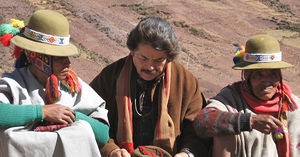
Don Americo Yabar & Q'ero Paqos
What has drawn me to associate with Americo is (among other things) his integrity, his love, and his joy of life. ‘Walking your talk’ is for me a minimum requirement for a path with a heart. Americo not only walks his talk, his walk is even more expressive and impressive than his talk (and as a mystic who is also a poet he talks very beautifully indeed). Anywhere I go with Americo in the Andes, from Cusco to the smallest village, people come running up with smiles, or lean out of a window and wave in delight to see Americo. Being with him is an instant ticket to having the opportunity to interact with the villagers at a heart-felt level, this is an opportunity I always embrace, and is an important part of the ineffable beauty and power of my experiences in Peru. While Americo is an impressive mystic in the traditional sense (whatever the hell that means) the path he walks shows up most profoundly in the way in which he interacts with the people of Peru, and does what he can to help them get by, and works to nourish their roots in their traditional culture.
For all of that, Americo is “just this guy, you know?” (description of Zaphod Beeblebrox, galatic president, in Douglas Adams’ Hitchhikers Guide to the Galaxy), not a Saint, not a guru, just a very human guy. I find this attractive about the path as well, as we travel it we don’t turn into Americo Yabar clones, we instead begin to blossom into who we uniquely are, we don’t rise above our humanity, we begin instead to express its true nature.

Don Americo and me in Peru
Share...


© 2026 Salka Wind Blog
Theme by Anders Noren — Up ↑