Posts on the Andean Cosmovision

Year: 2017 (Page 3 of 4)

Workshop Details

In my previous post (Wildflower Seeds) I expressed my desire to begin giving  workshops in more areas of the globe, and I mentioned that I am going to Europe in August.  For those of you who have expressed some interest (and those who might) I thought it would be helpful for me to provide more details about my workshop.

Content:  The Andean Cosmovision

The Andean Cosmovision is a beautiful and mysterious way of perceiving and interacting with reality that comes from the ancient culture of the high Andes. It is fundamentally different than the Western worldview. The Andean Cosmovision is not a set of concepts of beliefs. It cannot be described or encompassed by words. It can, however, be experienced and it can be explored

Simple Andean meditations serve as portals for entering into and exploring the Andean Cosmovision. On this path we come into contact with profound facets of ourselves and the Cosmos. The meditations also nourish a more loving and mutually-supportive relationship between ourselves and nature, a relationship that may be exactly what our species needs to head toward a more beautiful and healthy future for our planet.

You do not need a guru to follow this path. You need the Pachamama (the great being who is our mother Earth), the Apus (the great beings who are the majestic mountain peaks), you need the stars the wind, the trees the rivers, the sun. These beings serve as co-creators of our conscious experience first within the meditations and then within our lives. The effect on us is that we begin to blossom into the full beauty of who we each uniquely are.

In his presentations and workshops Oakley opens the door to this new territory, introducing you to some of the meditations, giving you a taste of what you may find, and sharing some advice on how to proceed to explore it on your own.  After each meditation you notice its effect on you, and then you decide whether or not to add the meditation to your repertoire of ways to dance with the great mystery that is the Cosmos and our existence within in. There is no moral imperative that this path be taken. If you like the experiences then proceed, it only gets better. If not, then turn to some other path, for there are many beautiful paths available to us and no path works for everyone.

About Oakley Gordon

I received my doctorate in cognitive psychology (the study of perception, learning, memory, and consciousness). For the past twenty two years I have been exploring the Andean Cosmovision under the tutelage of my Peruvian mentor and friend don Américo Yábar and Américo’s son don Gayle Yábar. In my many trips to Peru I have also worked with numerous other Andean paqos (mystics/shamans) and healers. I have shared the Andean Cosmovision with Western society through papers at academic conferences, presentations to the public, published articles, an extensive blog, my book (The Andean Cosmovision: A Path for Exploring Profound Aspects of Ourselves, Nature, and the Cosmos), and several hundred experiential classes and workshops. They come from my heart (with help from my intellect).

Presentations/Workshops/Classes

I have listed below several of the ways I usually share the Andean Cosmovision. They are meant to give you an idea of the sorts of things I usually offer, other options are welcome.

  1. Book signings. Needless to say I am delighted to let people know about my book The Andean Cosmovision: A Path for Exploring Profound Aspects of Ourselves, Nature, and the Cosmos. The book is a how-to guide for exploring the Andean Cosmovision. It also addresses how to integrate what we discover there with our life here in the West. I am happy to include with the book signing a short presentation on the Andean Cosmovision.
  2. Introductory Presentation (usually 60 or 90 minutes). In this amount of time I can give a fairly thorough presentation on the Andean Cosmovision .  If the context is appropriate I will lead everyone through a short meditation they can do while sitting in their chairs. If the participants would like to then proceed to actually explore the Andean Cosmovision on their own the meditations are available in my book or for free on my blog.
  3. Introductory Presentation with Meditations (usually 90 minutes). As the Andean Cosmovision cannot be encompassed or described with words, but can be explored experientially, my presentations become fundamentally deeper and richer when combined with the opportunity for us to engage in some of the meditations. I like to include three or four short meditations with the presentation.

These specific meditations are best done while sitting on the floor or (even better) on the earth. For those who cannot sit on the floor the meditations can also be done while sitting in a chair, but they are “juicier” when sitting on the ground. Many people cannot sit comfortably on the ground for 90 minutes, so it is nice to be able to move from sitting in chairs during the talking part to sitting on the ground for the meditations.

  1. Andean Meditation Workshops (2 hours to 2 days). While there is a lot that can be said about the Andean Cosmovision, it can only be understood and explored experientially, and not through words (“the Tao that can be talked about is not the Tao”). The Andean meditations provide a means for experiencing and exploring the Andean Cosmovision. Each meditation serves as a portal into a fascinating corner of the Cosmos.

My Andean meditation workshops have three basic aspects. First, I like to talk to people about the Andean Cosmovision and introduce some concepts and terms that serve as a bridge from the Western worldview to the Andean Cosmovision. Second, I lead us all through some of the meditations. This is the heart of the matter, for this is when we actually enter into the Cosmovision, even if just a few steps. This is usually sufficient for a person to decide whether this meditation is something they may want to explore further. And third, I think it is important that we learn how to integrate what we experience in the meditations with our lives here in the West, for then we begin to see how to move our society toward a future of greater beauty and health for this planet.

The length of the workshop determines how deeply we go together into the Andean Cosmovision and how many meditations I can lead us through. It is not, however, about quantity. My intent is to teach you how to do the meditations and to give you some advice on how to continue to explore on your own. After that the adventure is yours. As each meditation is a portal into a different neighborhood of the Cosmos, even just a few meditations can provide a lifetime’s worth of adventure. I can understand the desire to know more and more meditations, for that is why I know as many as I do, I kept asking. I have found, however, that I have turned to the simplest and first Andean meditations I learned to serve as the foundation of my meditative practice. My book and my blog provide many more meditations for people to explore.

Duration. The meditations change our energy. It is possible and desirable to string together two or three meditations that harmonize together. Too many different types of meditations in a short period of time, however, just scrambles our energy in an inharmonious way. Therefore there is some wisdom that needs to be applied in the workshops. I usually organize workshops into 90 minute segments, with a short break in the middle of the segment, and a good 20 minute break or so between segments. After three hours of workshop it is good to take a long break, at least two hours, to have a meal and rest. A total of six hours of workshop in one day is pushing what people can do, and I don’t advise trying to go over that.

Within those limits all kinds of options arise. A two-hour workshop, or a three-hour workshop, which can be in the morning, afternoon, or evening. A three-hour workshop in the morning or afternoon, followed by a two or three-hour workshop after lunch or dinner. I am sometimes asked to give a 90 minute presentation one night and then a workshop the next day. Whatever, we are free to play.

Location. This is really important. The heart of the Andean meditations involves our relationship with nature and the Cosmos. Most of the meditations are best done outdoors and some can only be done outdoors. I can give a 90 minute or perhaps a two-hour workshop indoors, but to really touch the heart of the path, and for any workshop longer than two-hours, we really need to be outdoors for most of the time if at all possible. This is not always easy, I know. I’ve had to organize many a workshop around this central point. Here is what we need:

  1. A natural setting outdoors. It is better if it is salka (undomesticated). In other words, a natural meadow or woods is better than a park that has been shaped by the human mind.
  2. People can be self-conscious when meditating in public, so a place for us to be that is somewhat out of the public way is good.
  3. It is much better if the place is not overwhelmed with industrial noises.
  4. People cannot meditative when they are being rained on, baking in the sun, or being bitten by bugs. They need to be protected from these. One possibility is to move to an alternative indoor setting if it rains.
  5. Some of the meditations involve sitting on the ground, some involve lying on the ground and some involve standing. Most people can’t sit on the ground for a long time. What I have found works well is for everyone to have a camp chair they can sit in while we are talking, a blanket for when we are lying on the ground, and a sitting pad for when we are sitting on the ground to meditate.
  6. There is a beautiful meditation that can only be done while sitting next to a (not very polluted) river, and another one that can only be done near trees tall enough to lean against. If that can be arranged it is great. If not then those meditations can be skipped. Traveling to various natural spots during a workshop is fun and also provides a beneficial change in energy.

My compensation for giving a workshop or presentation (in other words my ayni) is open to discussion.

If there is any more information you would like regarding my workshops please feel free to contact me, Oakley Gordon, at info@SalkaWind.com.


Share... Facebooktwitterredditpinterestlinkedinmail

Wildflower Seeds — Workshops — Europe

Tossing salka seeds into the wind.

As part of my (self-directed) participation in the poetic salka movement on this planet I have written this blog, and a book, and have given presentations at academic conferences, and have taught several hundred Andean (salka) meditation classes and workshops in Utah. I would like to also offer presentations, classes, and workshops in other areas of the country and other places on the planet. The only way I can think to nourish this happening is to let you all know that I am available and interested.

Part of the cost in having me come to your area is the expense of transporting me there. But if I happen to be in the neighborhood anyway…..

This August my wife and I will be vacationing in Europe. I would love to connect with waikis in Europe while we are there. If you would be interested in arranging for me to give a presentation on the Andean Cosmovision, or an Andean (salka) meditation class, or a short workshop, please contact me at info@SalkaWind.com. I can let you know the types of presentations/classes/workshops  I offer and if you are interested we can talk dates, logistics, and ayni.

Thanks waikis!

P.S. My academic vita can be found in this blog on the page Oakley’s Vita.

P.P.S.  The poetic salka movement on the planet was founded by don Américo Yábar and don Gayle Yábar who deserve all of the credit for the beauty of the path they have shown me.

Share... Facebooktwitterredditpinterestlinkedinmail

Milestone

In December of 2016 I reached a milestone for me, I sold my 1000th copy of my book, “The Andean Cosmovision: A Path for Exploring Profound Aspects of Ourselves, Nature, and the Cosmos“.  In addition to just announcing that remarkable (to me) fact I would like to share a little about the book and my process and what I hoped to accomplish by writing it.

As a young man I used to be a voracious reader of books about consciousness, Taoism, Sufism, Buddhism, meditation, lucid dreaming, altered states of consciousness, and many other related topics. I developed an intellectual understanding of those topics that was both deep and broad. When I met don Américo Yábar in 1994 and he invited me to be his student I realized that I was embarking upon an exploration where words and concepts would be of no avail. I completely stopped reading about consciousness. I wanted to enter into a new way of experiencing reality and I did not want my thoughts (so steeped in the Western world) and the thoughts of others to shape and distort my experinces. I decided to simply experience the Andean Cosmovision, and then eventually, perhaps, I could write about those experiences. I wanted the experiences to inform my thinking and writing and not the other way around.

For roughly 18 years I let my heart and my body and perhaps my spirit lead me in this exploration. When I would return to Peru I would try to make sense of my experiences after the fact, as I worked to integrate this new experience of reality with my continuing life in the West. For several years Américo encouraged me to write a book but I knew I wasn’t ready. Finally I did. I had a hard time starting as the ‘book project’ seemed so huge and massively tricky to pull off while remaining true to the experiences. A friend of mine suggested that I begin by writing a blog where I could get my ideas out piece by piece and then write my book. So I did, and it worked.

My goal in writing the book is to help nourish salka on this planet. It is not a message that “should” be heard, it is a message that might touch others as deeply as it has touched me. I also believe that the path described in the book, the path of heart into the Andean Cosmovision, could help change the trajectory of our society toward a future of greater health and beauty. I self-published the book to get it out more quickly and to insure that it would say exactly what I wanted it to say. I hope each copy is a like a pebble tossed into a pond, with ripples of influence spreading out.

When I went the route of self-publishing I knew the number of books sold might be small. As some sort of marker I thought that if I could sell 100 copies then I would feel that the extensive effort I put into the book (and innumerable lattes) would be worth it. I am more than gratified to have sold 1000 copies, with almost no advertising, just word of mouth. No path works for everyone, nor does this book, some people have reported that they stopped reading it part way through, but more have been along the lines of a reviewer who said that he keeps a copy of the book strapped to his body. That’s how I feel! Thank you to all of my friends and to those who have bought the book and told others. I really appreciate it. Love, Oakley

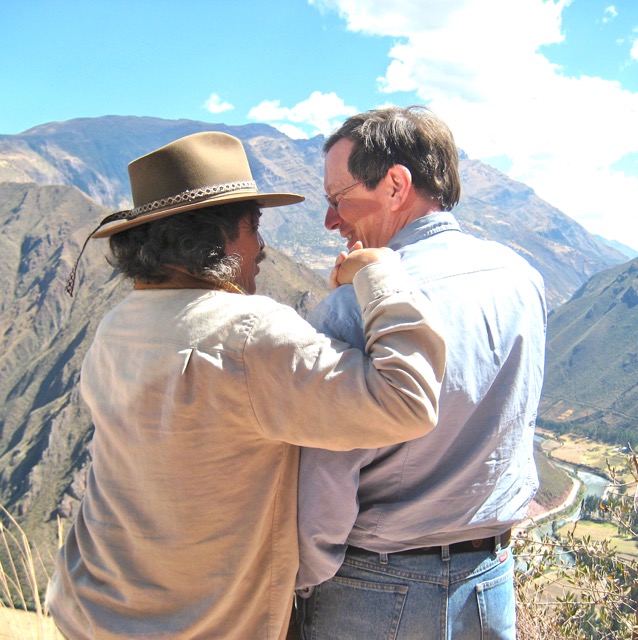
Don Américo and me in Peru.

Share... Facebooktwitterredditpinterestlinkedinmail

An Organized Table of Contents

Hi, I have written so many posts for this blog that I thought you might like to have a Table of Contents that organizes them into various categories. It is particularly important to me that you have an easy way to find the meditations, as they are the heart of this path.  You may access the table through the link below or through the menu on the right side of each page, in the “Blog Support Pages” list.

  Table of Contents

Share... Facebooktwitterredditpinterestlinkedinmail

The Creature and its Creations

Don Américo Yábar

The first part of this post was inspired by Alan Watts (1915-1973) and his book Nature, Man, and Woman. Watts was a wonderful writer and philosopher best known for bringing Eastern philosophy into Western culture. His titles include The Way of Zen, Tao: The Watercourse Way, This is It, Psychotherapy East and West, The New Alchemy, The Joyous Cosmology, and The Book: On the Taboo Against Knowing Who You Are.

I would like to begin by asking the question, “Are we more like clocks or are we more like flowers?”

Let us begin by considering clocks. Clocks are created to fulfill a purpose, which is to indicate the time. After the purpose of the clock has been determined we can apply our rational mind to how to construct such an object. From this design various parts are manufactured and assembled into a working clock. The creation of a clock, then, has these elements: 1) it is created by a creator who stands outside of the clock itself; 2) the clock consists of pieces that were made first and then assembled into a whole; and 3) the clock was created to meet some purpose.

Now let us move on to flowers. First, we note that flowers don’t have pieces. They have petals, and stems, and roots but these are all part of a whole. We can break off the petals and call them pieces, but they weren’t created first and then glued on to the stem, they emerged from the stem, and once we turn them into pieces by breaking them off we can’t snap them back into place. Second we note that flowers are not constructed from the outside. Flowers grow from within. The growth of the flowers is informed by the seed (using the the old-fashioned meaning of “informed” which is “to give shape from within”). And third, the flower has no purpose, at least not the sort of rational purpose that goes into making a clock. Flowers weren’t created with a purpose and then inserted into the web of life. They co-evolved with other life, with pollinating insects in particular. Flowers do play an important role in the interrelations of life on the planet. This role was not rationally decided upon from outside the dance of co-evolving life but emerged from within that dance, a dance that earlier proto-flowers had a part in.

In Western society we are very familiar with the process of making things like clocks and computers and houses…and dinner. When we turn to consider who or what made us, and made the Cosmos, it is natural to conceive of a Creator in our own image. Such a Creator would exist outside of the Cosmos that he/she/it created, the Cosmos would consist of individual pieces, and the creation and its pieces (e.g. we humans) would be created for some purpose.

What if a growing flower, however, is the better metaphor for existence and creation, that the Cosmos grew from within, that everything is interconnected, that the creator is not an external God but an internal blossoming, that the Cosmos created itself from within and continues to do so? Well, if this is the better metaphor then we are left with no “purpose” for our existence. Poor us and poor flower!

Alan Watts says about this, “Such a line of thought may be … disturbing, since it suggests a universe of life which has no motive at all…and surely an absolutely purposeless world would be the most depressing of all possibilities.” He then goes on to say, “But the idea of a purposeless world is horrifying because it is incomplete. Purpose is a preeminently human attribute.”

In the dictionary purpose is defined as the reason for which something is done or created or for which something exits. To say that we, and the Cosmos, have no purpose is simply to say that our existence is not the product of rational thought, and that is far from saying what we are the product of, which would be nature and the Cosmos.

Again, turning to Watts.“To say that the world has no purpose is to say that it is not human, or, as the Tao Te Ching puts it: ‘Heaven and Earth are not human-hearted (the Chinese character “jen”)’. But it continues: ‘The sage is not human-hearted‘ (Tao Te Ching, Chapter V).”

What I propose Heaven and Earth (and sages) are is Cosmic-hearted. This flow of thought brings us to the “path of the heart” (see the previous post Paths to the Other Side of Reality). The path of heart does not lead to the human heart and its emotions, it leads through the human heart (actually the munay) to the heart of the Cosmos. This is what underlies the Andean meditations and also underlies salka. The Cosmic heart occasionally shines through the cracks of our reality while we are meditating, and when it does we experience the meaning of our existence.

Returning to earth, I would like to now consider the work of Gregory Bateson (1904-1980). Bateson was an anthropologist, social scientist, and linguist who helped create the discipline of cybernetics (also known as “systems theory”).  He was a pioneer in using cybernetics to explain social, psychological, biological, and ecological systems. Bateson proposed an elegant definition of “mind”  that resolved the “mind/body” problem (the situation where the mind seems to be both transcendent to the physical realm yet also seems to be just a byproduct of the physical realm). It would take too long and be largely irrelevant to describe his solution here but a consequence of it is that both humans and larger ecological systems fit his definition of having a mind.  From within this perspective we can see that human creativity and biological evolution share the same processes, and one is a special case of the other.

Bateson took the cybernetic explanation as far as it could go, eventually tackling the nature of the sacred in his aptly titled book “Angels Fear: Toward an Epistemology of the Sacred”. Some of Bateson’s ideas have appeared earlier in this blog, and in my book, under the titles “Why a Swan?” and “Lesson of the Mask .

The following is from the chapter The Creature and its Creations in his book A Sacred Unity: Further Steps to an Ecology of Mind. In his very logical and erudite way Bateson begins by making the case that creations give us insights into the creatures that created them.  He then turns to the narrative poem Peter Bell by William Wordsworth, and says:

“Wordsworth mocks that to Peter Bell,

‘A primrose by a river’s brim

A yellow primrose was to him,

And it was nothing more.'”

Bateson proposes that, “To the poet, the primrose can be something more. I suggest that this something more is, in fact, a self-reflexive recognition. The primrose resembles a poem and both poem and primrose resemble the poet. He learns about himself as a creator when he looks at the primrose. His pride is enhanced to see himself as a contributor to the vast processes which the primrose exemplifies. And his humility is exercised and made valid by recognizing himself as a tiny product of those processes.”

Yes, he writes that way.

My original intent in creating this post was to share the related thoughts by Alan Watts and Gregory Bateson about the underlying processes of the Cosmos, thoughts that have helped me integrate my experiences in the Andean Cosmovision with my intellectual Western worldview.  As I have been writing, however, another thought has arisen that I would like to include.

Many years ago don Américo recommended to me that ‘we make our lives a work of art”.  I have always loved that advice.  In thinking about it now I see it as a way of having my life be more in accord with the processes of the Cosmos itself.  I think about the world a lot, and when I do I often get to a decision that seems to have no rational best choice;  “On the one hand I could…” and “but on the other hand I could…”  This is very familiar territory for me.  When I remember Americo’s advice I turn back to the options and ask myself which would be the more artistic path to take.  When I do the choice is usually obvious.


Share... Facebooktwitterredditpinterestlinkedinmail
« Older posts Newer posts »

© 2026 Salka Wind Blog

Theme by Anders NorenUp ↑