Posts on the Andean Cosmovision

Tag: cosmovision (Page 5 of 5)

Pacha and the Three Worlds

This post will serve as a lead-in to one of my favorite meditations from the Andes. It is another meditation that I have learned from don Americo Yabar. The meditation involves connecting with the three levels of existence, the ‘Three Worlds’, of the Andean Cosmovision. They are the ‘uju pacha’ (the ‘lower world’), the ‘kay pacha’ (the ‘surface world’) and the ‘janaq pacha’ (the ‘upper world’). I have given these Quechua words the spelling they would have if written in Spanish. Phonetically in English they would roughly be ‘ukhu pacha’, ‘kie pacha’, and ‘hanak pacha’.

Like all of the meditations I have shared, this meditation is quite simple. As I began exploring it, however, I found that I wanted to have a better understanding of what the meditation was all about. In searching my notes I found only the briefest descriptions from Americo concerning the uju pacha, kay pacha, and janaq pacha. I decided to turn to what literature is available on the Andean Cosmovision to see if I could flesh out my understanding of these terms. What I found has helped me to hone my intent with the meditations, and I have really enjoyed the results. I would like to share with you what I have found (but keep in mind the fallacies I posted earlier).

The three worlds of uju pacha, kay pacha, and janaq pacha are so fundamental to the Andean Cosmovision that there is actually a fair amount of information available concerning how the Andean people interpret these terms. These interpretations, however, vary widely across the sources I have found.

Part of the breadth of meaning of the three terms comes from the 500 years of Christian influence on the Andean culture. It takes no great conceptual leap to link the uju pacha (the lower world) with the Christian concept of hell, and the janaq pacha (the upper world) with the Christian concept of heaven, and this has changed the meaning of the terms in the post-conquest culture. Even the Q’ero, the people with whom I have worked and who are viewed by many as being among the purer ‘keepers of the flame’ of the indigenous Andean Cosmovision readily identify themselves as being Christian (see Wilcox, 2004). What they exactly mean by this is hard to say. It brings to mind my hearing the women in Mollamarka, Peru sing about Apu Jesucristo (loosely translated as ‘Jesus the Sacred Mountain’).

If we look at the conceptualization of the three worlds which predates the Christian conquest of the Andes then a very different understanding emerges. Even then, however, there are still some differences among sources concerning how these terms are to be interpreted. When faced with a multitude of interpretations of the nature of the uju pacha, kay pacha, and janaq pacha, what did I do? I picked the one I liked, the one that fit my understanding of the Andean Cosmovision, and ultimately the one that enhanced the power of the meditation.

The following description of the nature of the uju pacha, kay pacha, and janaq pachca is based upon a chapter entitled ‘Andean Cosmology and Cosmography in the North-Peruvian Shamanic Mesa’, written by Mario Polia, in the book Mesas & Cosmologies in the Central Andes, edited by Douglas Sharon (2006). An understanding of these three terms depends upon an understanding of the word ‘pacha’.

The Quechua word ‘pacha’ does not correspond directly to any term or concept we have in the West. It is, instead, a bringing together of three of our concepts, an integration of place, time, and consciousness. One facet of ‘pacha’ encompasses the concept of space/earth/world/place. We have already in this blog run across Pachamama as the great Being who is the planet Earth. A second facet of ‘pacha’ involves time/era/period. The term ‘tarpui pacha’, for example, is the time for the sowing of seeds. ‘Pacha’ thus encompasses both place/location and time/period, a particular location at a particular time, but there is a third element involved in ‘pacha’, namely consciousness. In the Andean Cosmovision consciousness is an inherent, immanent, aspect of the Cosmos, if we are talking about a time and a place then we are talking about consciousness as well. Now let’s take this idea of ‘pacha’ and develop a useful understanding of the ‘uju pacha’, ‘kay pacha’, and ‘janaq pacha’.

In terms of a world, or location, or place the uju pacha is the lower world, the world below, the interior world, a place associated with the depths of the planet. When the Andean people want to communicate with the uju pacha they may go to a spring or to a crack in the earth’s surface that provides a conduit into the interior of the world. The uju pacha is the deeply interior world, closer to the surface is the ‘urin pacha’, where seeds are planted to take root and grow. The uju pacha also refers to time, in this case it is the past, the distant past (uju pacha) and the recent past (urin pacha). The uju pacha is the time of our ancestors and before. I like to think of the urin pacha, the more recent past, as the time when seeds were planted in our lives that have blossomed into who we were, who we are now and who we are about to become. Connection with the uju pacha is accomplished by connecting to the interior world (e.g. the interior of the planet) and intrinsically tied to that act is the connection with the past, both distant and recent. Consciousness exists outside of all of our mind’s constructs of space and time so whatever consciousness is it is there and then as well.

The kay pacha is the surface world, the world in which we live, and it is also present time, not necessarily this exact moment of Now but the general neighborhood of time around it.

The third world, the janaq pacha, is the superior world, the world above. The near above, the realm of the majestic mountain peaks, is known as the janan pacha. The janaq pacha is the highest zone, the realm of the stars, ‘the seat of archetypal forms of spiritual principle of all living things’ (Polia, pg 35). The janan pacha and janaq pacha also refer to the future, the near and distant future respectively. Connection with the janaq pacha is accomplished by connecting to the sky above, possibly as far as the stars themselves, and this is intrinsically tied to connecting with the future. If connecting with the uju pacha connects us to the seeds that have blossomed into who we were, who we are now, and who we are about to be, connecting with the janaq pacha is a connection to who we are in the future as Beings in harmony with the archetypal forms of the spiritual principle of all living things. And of course, consciousness, which is outside of time and space, is there and then too.

As Beings we are older than the Grand Canyon, but not as old as the stars.  don Americo Yabar.

Next post, a meditation which brings this into blossom.


Share... Facebooktwitterredditpinterestlinkedinmail

Ayni

I would like to turn now to what may be the most fundamental aspect of the Andean Cosmovision, ‘ayni‘.  Ayni is the principle of reciprocity. The essence of ayni is that when you receive something you give something back in return. This keeps balance in the relationship, but it also does more than that, it nourishes the relationship as well.

Ayni informs the Andean people’s relationships with each other, and in that context it can be easily understood. It is when the Andean people apply ayni to their relationship with Nature and the Cosmos that we move into mysterious territory and begin to glimpse the profound beauty of their Cosmovision. To understand how ayni works in this context we first need to understand their very different view of Nature and the Cosmos. It is not possible to have a true relationship with inert, mindless, matter, and in the Western view of reality that is how rivers, and stones, and trees, and the Cosmos itself are basically seen. We can love a forest, or the Earth, but within our world view it is hard to conceive of them loving us back. The Andean people have a very different experience of reality, one that allows true relationships with Nature and the Cosmos. This was covered in the earlier post  Andean Cosmovision: The Basics and I recommend that if you haven’t already that you read it and the post Barefoot in the Mountains before proceeding so that you will be better able to understand what I am going to say about ayni.
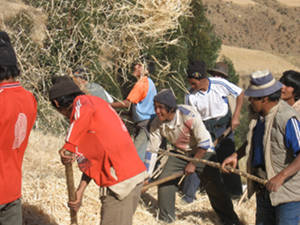
Village men threshing wheat

Village men threshing wheat.

Let us begin by looking at ayni in the context of the Andean people and their relationships with each other. Ayni shows up clearly in the work that the people in a village perform together. When it is time to work a family’s field the men and women in the community unite to work it as a community. The sowing of a field, for example, involves a line of men working foot plows to overturn the soil, followed by a line of women who plant the seeds. When such communal work is done the recipients rarely express thanks, for it is just part of life that they will then establish balance by working their neighbor’s fields in turn. When you give you receive, and when you receive you give, balance is maintained, both sides are nourished, and the community is healthy.

Reciprocity is like a pump at the heart of Andean life. The constant give-and-take of ayni…maintains a flow of energy throughout the ayllu [community]. Allen, 2002, pg 73.

I would like to share some of my own experiences with ayni, from the perspective of a Westerner entering into a relationship with the Andean people. My trips to Peru involve working with various paqos and healers, and this ‘working with’ often involves my participation in the ceremonies and healing rituals that they provide. What I can give them in return to balance our relationship, what they really need that I have, is money.

At the beginning of my exploration of the Andean Cosmovision I felt uncomfortable about giving money in reciprocity. From my Western perspective it just didn’t seem quite right to give money for a sacred experience. There is a lot of cultural background to those feelings, tied to our views about the relationship between the sacred and the secular and how– when the two are mixed in the wrong way–the sacred becomes profane. Ayni, however, is not the same thing as payment. Ayni brings people closer together, the goal is balance rather than gain, mutual support rather than advantage. When I was able to shift from my culture’s Cosmovision to the Andean Cosmovision I was able to enter into the true ayni of the relationship. On their side they were willing to do the same, to interact with me in ayni within the context of the ceremony, rather than slipping into the Western capitalistic relationship that is encroaching into their culture. It is interesting that when the ceremony is over, and ayni has been completed by my giving them money, then the context usually does shift, the sense of the sacred evaporates, they pull out their goods-for-sale, and some hard haggling begins. The two ways of being in relationship, one of ayni within the context of the sacred, and one within the context of selling, could not be more different.

I would now like to share another context where I experienced how ayni works in Peru. This specific instance occurred in one of my more recent trips. I had brought along some extra money to give to the people of the Andes, not much, but it doesn’t take much to really help out someone who lives in the high Andes. The challenge was to find a context where the money could be given in ayni, for it is so easy for it to shift into a context of “the (comparatively) rich Westerner giving money to the poor and needy indigenous person” which is not ayni at all.

I was able to proceed with the help of an Andean friend (who is a genius at getting around my misled but well-intentioned efforts and helping me to do something even more beautiful than I anticipated). In this case we were in a very small village high in the Andes, which was probably important as there the people still lived a life governed by ayni. The following story is perhaps the best way I can share how ayni works.
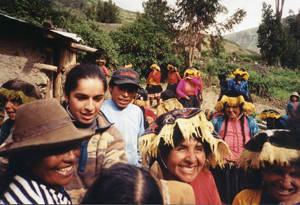
Women of a village Club of Mothers

Club of Mothers

I was introduced to several people whom my friend knew could use some help. First I was introduced to a middle-aged man who was suffering from severe diarrhea, he asked if I had anything to help. Being the well-prepared gringo that I am of course I had some medication that is good for diarrhea, and I gave him some with instructions on how to take it. He thanked me most sincerely, and a few minutes later he returned to give me three eggs from his hens, which of course I thought was pretty nice of him. Then I was introduced to two young girls who were orphans and needed some money to get school supplies (in the small villages there are few resources for people who are outside of any family). They smiled and looked shy. I gave them some money and with big smiles they each gave me a hug, then one ran out and returned with a belt she had made to give to me as a present. The village Club of Mothers (who meet weekly to pursue activities for the benefit of the children in the village) gave me a live chicken in ayni for my support. I contemplated texting my sons that I was bringing them home a sister but we ate the chicken that night instead. And at the end of the day I was introduced to a very old woman whose family were all gone and I gave her the rest of what I had. She gently grasped my hand with both of hers and looked into my eyes with a gentle smile and said something to me in Quechua, which my friend translated for me. She said that she had nothing she could give me, so she would pray for me instead. It was a beautiful day.

While ayni in the relationships among humans may be easy for us to understand from our own cultural perspective, when we look at the Andean people’s ayni with the animals upon which they depend then we start to move into territory that is both different and beautiful. I would like to talk about the relationship between the Andean people and their traditional domesticated animals, specifically alpacas and llamas. The following description pertains to people who live in isolated villages in the high Andes, at or above the tree line, and who still live the Andean Cosmovision. These people, and their animals, and their plants, eek out a living at altitudes as high as 15,000 feet, in villages that may be a good two-day walk from the nearest road.

The alpacas and llamas make it possible for the Andeans to live at such altitudes. Unlike other ruminants, alpacas and llamas can graze upon the sparse, high-altitude, grass without damaging it . Llamas carry loads to and from the fields, and from one village to another. They can carry 70 – 90 pound packs, up to 16 miles a day. The hides and wool from both llamas and alpacas are used for clothing. Wool from the alpacas is sold in market towns to obtain sugar, and flour and other materials that cannot be produced in the village. When an animal is slaughtered or offered in a sacrifice every part of the animal is either consumed or used to make things. Dung from the animals fertilize the high-altitude fields or when dried can be used as fuel (it is not a very hot fuel, one time we decided to make hot chocolate at 17,000 feet and it took over an hour for the water to get kind of warm).

The Andean people recognize that their alpacas and llamas cannot survive without human protection, and they equally recognize that humans cannot survive without the alpacas and llamas. The people and their animals share the same resources, and the same weather, and the same hardships of life at high altitudes. The llamas and alpacas are not seen as resources to be managed, they are seen as partners in a mutually supportive dance of reciprocity among beings.

The llamas and alpacas are treated with love and respect, an Andean herder knows every llama and alpaca by sight and all are given names. The llamas and alpacas participate–adorned–in sacred ceremonies, so that the ceremonies may make them happy too. They join the people in appealing to Nature and the Cosmos in times of need.  Special ceremonies are held in honor of the llamas and alpacas. In the llama ch’allay ceremony, for example, the llamas are given chicha (locally brewed corn beer) to thank them for all of their work in carrying the harvests up the mountain. During the ceremony a small bell is rung near the llama’s ear to clean its energy.

When an alpaca or llama is sacrificed or slaughtered the event calls for a special ritual. The animal’s feet are tied together and it is laid upon the ground with it’s head in a person’s lap. The person sings to the animal and strokes its head and gently feeds it coca leaves. At the appropriate moment the animal is killed swiftly, and as it dies its feet are untied so that its spirit may begin its run to the sacred mountain Apu Asungate, accompanied by prayers by the people that Asungate may receive the spirit and send it back to be born again in the same corral. Through its death the animal’s spirit is a gift to the Apu who returns the spirit back to the herd in ayni.

As the life force [of the animal] flows towards the mountains and back in perfect reciprocity, the cosmic balance is maintained. (Bolin, 1998, pg 56).

Market at Pisac

Bounty from the Pachamama and her daughters

Now we will take a step yet further away from the Western view of reality to consider ayni in the relationship of humans with the Cosmos when it comes to raising crops. As the Pachamama (the great mother who is the planet Earth) is but a part of the conscious Cosmos yet has her own consciousness, and the Apus (majestic mountain peaks) are but part of the Pachamama yet have their own consciousness, the chakras (fields in which crops are grown) are daughters of the Pachamama and have their own consciousness as well. Each chakra is responsible for the crop that is grown upon her, and each chakra has a name given by the people who work that field. Before entering a chakra to work a brief ritual of gratitude and respect is given to the Pachamama and her daughter. A little chicha (corn beer) may be poured upon the ground to slake their thirsts. Upon leaving the field another brief ritual may given to thank them for their generosity, in this way ayni is nourished. At that time a little thanks may also be given to Illapa, the god of thunder, thanking him for sending the rain (and for not sending lightning).

Patchwork quilt of chakras on the lap of the Pachamama

Patchwork quilt on the lap of the Pachamama

On one of my trips to Peru we stopped to watch the people gather a harvest of potatoes. It was in the high Andes, on the land between Cusco and the Sacred Valley. The numerous plots were all small, and at different stages of ripeness and containing various crops. The ground stretching up to the mountains looked like a patchwork quilt upon the lap of the Pachamama. Thin trails of smoke rose from a dozen small camp fires scattered across the land. The fires were tended by young mothers and older women. The first potatoes taken out of the ground in the morning had been placed back into holes dug in the Pachamama, covered with earth, and then a fire was lit above them, cooking the potatoes for a meal later in the day. The custom is both practical and sacred, honoring the Pachamama, nourishing her children, and maintaining the relationship between the earth and those that live off of her bounty.

After appreciating this sight, we piled back into our van to continue on our way. As we pulled out my gaze fell upon a young woman tending a fire near the road, perhaps 20 yards away. She looked to be in her early twenties. She was wearing the traditional full skirt and sweater of the Andes made of a woven fabric dyed in colorful shades of green and brown, and a tan hat with a rounded top and a wide flat brim. She was sitting on the ground, in contact with the Pachamama, and nursing her child. As the van pulled away she looked up and for a moment our eyes met, and she smiled. It was the most beautiful smile I have ever seen, a smile that conveyed an absolute contentment with life-at-that-moment, a smile from the heart of the Pachamama.

In the Andean Cosmovision humans are not distinct from Nature, nor is Nature distinct from the Cosmos. The role of humans is not to use Nature for our own good, nor to serve as stewards over it, but instead to interact with Nature in a dance of respect and mutual support. We are but part of the fabric of life, not its apex; children of the Pachamama, but not her special children. Is it any wonder that the fields that the Andeans have cultivated for thousands of years feel as wild and natural as our National Parks?

In the Andes ayni goes beyond the people’s relationships with each other, and with animals, and with fields, to inform their relationships with the Cosmos. When the Andeans gather together socially, or in ceremony, or to do communal work, they perform brief ceremonies to invite into their circle the Pachamama and the Apus and other great Beings of the Cosmos, to honor them and to express respect and gratitude. In their sacred ceremonies, the Andean people offer gifts to the Pachamama, to the Apus, and to the various other Beings of Nature and the Cosmos. This is all done as ayni, to nourish a relationship of mutual support, of mutual service. They serve the Cosmos and the Cosmos serves them, and from this their sense of relationship becomes stronger.

Inge Bolin (1998) summarizes a night of ceremony among the Andeans as follows:

These ancient rites reconfirm a close interdependence among humans, animals, and nature. This night, through a dialog with gods and spirits, we entered the realms of the sacred. We wove threads which symbolically bound us to our physical, social, and spiritual worlds. We reinforced ties with the past, with the Apus, with those ancestral spirits living in mountain peaks, and we looked toward the future, hoping for the aid and compassion of the deities from whom we requested health, prosperity, and peaceful coexistence. We engaged in reciprocity, the hallmark of Andean life; we were offering and asking, giving and taking.

Every gesture and movement was performed with great dignity and elegance. Every ritual carried an expression of respect for others—for gods, humans, animals, plants, and the spirit world. On this night and in the days to follow, the message of the rituals is clear. Only where there is respect can we find a way to live and act together. We must adjust and readjust to accommodate the various benevolent and malevolent forces within the cosmos. Pachamama, the giver of life, is also responsible for earthquakes and other disasters. The Apus are protectors of the herds, but they also send malevolent winds which can bring disease and death. There is no trace of aggression or hostility, domination, or subjugation in any of the rituals. Our offerings, our thoughts, our efforts in dedicating this night to a spiritual dialog among humans, animals, and the powers of nature are meant to reinforce the positive,, to give hope to a life so harmonic and serene, yet so vulnerable in this marginal environment. (pg 43)

This I believe is the heart of the Andean Cosmovision.  Ayni is the pump that sends the energy flowing through the people and their Cosmos. There is a mistake, I think, in our culture to remove the Andean meditations from their context, to see them only as a technology for personal transformation. The meditations, however, are fundamentally about our relationship with Nature and the Cosmos. The benefits of the meditations come from this relationship, and being a relationship we need to attend to our side of the relationship as well, with love and mutual support and respect.

There is one level of ayni I have not talked about yet that I would like to mention. The Andean people are willing to share their Cosmovision with the West and many of us feel that we have benefited greatly by their willingness to do so. For the circle of ayni to be completed, so that not only balance is achieved but that both sides may be nourished by the exchange, we need to give back to the Andean people, particularly those who have given this gift to us. I recommend that if you pursue more knowledge about the Andean approach from various authors and workshop presenters that you look to see if any of the money you give them goes back to the Andean people.

If you find this Salka Wind web site to be of value to you and would like to donate some money as ayni you can do so at the Donate page. This nourishes my efforts in this work and leaves me feeling like we are on this path together and that this project is the best thing since puffed rice. I always give a goodly chunk of any money I receive from my Salka Wind work to the Andean people to insure there is ayni at that level as well. If you would like to give some money to nonprofit organizations that work to benefit the Andean people–in a way that is guided with wisdom so that their lives and their culture are nourished rather than damaged–you will find links in the Resources page of this web site, there are undoubtably other good nonprofit organizations working to help the Andean people out there as well.

Note there is a subsequent post on ayni called ‘Ayni Revisited‘.

This post on ayni draws heavily from the work (cited and uncited) of Inge Bolin. I strongly recommend her beautiful book Rituals of Respect: The Secret of Survival in the High Peruvian Andes. I would also like to thank Monique Duphily whose dissertation-in-process on the topic of ayni also contributed to the writing of this post.

Share... Facebooktwitterredditpinterestlinkedinmail

The Three Centers of Being (Part 1)

In the Andes they identify three centers of our being; the yachay, the munay, and the llankay. Each center is located in a different part of the body and each provides a different way of perceiving and understanding reality.

The yachay is located in our head. It is our ability to think, in other words it is the intellect. In our culture, at least in my world of science and academia, logic is viewed as the epitome of thought. In the Andes, however, wisdom as a quality of thought is valued more than logic and intelligence. Wisdom is built upon life experiences, accompanied by an appreciation and understanding of the larger-than-individual and larger-than-humanity systems involved in any action. I would add that wisdom also implies some amount of caring and compassion. Wisdom, it would seem, implies a yachay that acts in accord with the other two centers, which we will turn to next.

The munay is located in our heart. It is the center of love. The ‘love’ associated with the munay, however, is not an emotion. Emotions are tightly connected to our thoughts. How we respond emotionally to an event is largely a product of the meaning we assign to it. But the love of the munay is not an emotion; it has nothing to do with romance or sex or sentimentality, and jealousy does not apply. Our yachay and its ability to analyze (i.e. break things into pieces) gives us the experience of being separate from everything else in the Cosmos. In the Andean Cosmovision the Cosmos is a vast network of interconnected filaments of energy and we, rather than being disconnected things, are part of that network. Through the munay we experience our connection with the rest of the Cosmos. The Cosmos has an underlying frequency, and it is our (beautiful) experience of tuning into that frequency through our munay that gets labelled with the closest available term ‘love’. (This definition of love comes to us from don Americo Yabar).

To experience reality through our munay we need to move our consciousness from our head to the area of our heart, and when we do, we experience a different way of perceiving and understanding the world. It may seem strange to speak of moving our consciousness to our heart (compared to, say, keeping our consciousness in our head and simply being aware of our heart). In my culture it is generally assumed that consciousness is always, must always, be in our head. The best way I have, however, for describing how to experience the munay or the llankay is that all we need to do is to move our consciousness there. I’ll be sharing some meditations for exploring this in later posts .

Now to the llankay. The llankay is located a couple of finger-breadths below our navel and a few inches inside our body. The llankay is the center of our physical being and its ability to come into physical manifestation. It is also described as our ability to work, to use our physical body to alter the world. At the center of the llankay is our ‘not-being’, where we are ‘no-thing’, from which our physical being emerges. The llankay is another location where we can place our consciousness and shift our experience of the Cosmos.

I have found the concept of these three centers (yachay, munay, and llankay) to be helpful in integrating my boy-scientist, Western upbringing (very yachay) with my experiences in Peru (very munay). Science, religion, philosophy are all of the yachay. They are immensely useful…and they cannot possibly understand the munay (and vice versa). The intellect can describe and explain and think about reality all it wants and it still does not overlap with reality as experienced by the munay or by the llankay. The integration of these three centers of being comes from a deeper level of ourselves. For me it was at this deeper level–beyond the distinction of the yachay, munay, and llankay–where the beauty and value of my explorations of munay eventually established a level of credibility that my intellect could acknowledge even if it could not understand.

I’ll be sharing some more thoughts about the yachay, munay, and llankay and providing some meditations related to them in upcoming posts (see below)

July 9, 2011:  The following subsequent posts are available:  The Three Centers of Being (Part 2), Tuning the Three Centers of Being.

Share... Facebooktwitterredditpinterestlinkedinmail

Andean Cosmovision: The Basics

One overriding factor to take into account when contemplating the Andean Cosmovision (view of the basic nature of the Cosmos) is that it is fundamentally different than that of Western* culture. This means that we can’t simply force their ideas into our own conceptual categories. The temptation to do so, however, is strong and rather automatic for we are accustomed to making sense of new things by relating them to what we already know.

We in the West essentially have two ways of viewing the basic nature of reality; through the lens of science or through the lens of (Western) religion. While these two approaches have some important differences they both arose within our culture and were built upon the same philosophical foundation. The indigenous Andean culture, however, does not share that foundation. Neither science nor religion have a counterpart in the Andean Cosmovision, and what they have (for which we have no corresponding terms) has no counterpart in our Cosmovision (or we would have corresponding terms).

Imagine, if you will, a view of reality that was not influenced by the Bible (where God as the creator stands outside of the creation and who made humans, alone of all the species, in His own image). It was not influenced by the classic Greek philosophers who emphasized the intellect as the highest form of knowledge, nor was it shaped by Descartes (the ‘Father of Modern Philosophy’) who proposed that reality consists of two separate realms, a transcendent realm of spirit and mind and a physical realm of mindless energy and matter. If we wish to explore the Andean Cosmovision we need to let go of our normal way of thinking about the world and approach it with room for it to be something brand new, we need to be a more accommodating (letting new information change how we view the world) and less assimilating (making new information fit how we already view the world).

The Andean Cosmovision is mystical in its essence. Mysticism is the belief that words (including beliefs) are, at best, signposts or blueprints for how to connect directly with the sacred underlying nature of reality, and that it is that connection with the Sacred–not the words or beliefs–that is of fundamental importance. The Andean Cosmovision is not primarily about their beliefs, it is about the experience of reality that becomes possible with these beliefs, it is about the relationship with Nature and with the Cosmos that becomes possible with these beliefs. Neighboring villages in Peru differ somewhat in what they believe, as do paqos (mystics/shamans) within the same village, but those differences are irrelevant to being a paqo, for what matters is what they can accomplish through those beliefs. What they can accomplish arises from the loving and mutually supportive relationship with Nature and the Cosmos that is made possible and nourished by their Cosmovision.

Here is my representation of the Andean Cosmovision. Imagine the Cosmos as consisting solely of filaments of energy organized into a tremendous three dimensional web. Where the filaments come together to form a bundle or a node is what we experience as an object. You are such a node, as am I, as is my coffee mug sitting here by my keyboard as I type. There are some important consequences of this world-view:

  1. Everything in the universe is part of this web of filaments and so ultimately everything in the universe is connected to everything else. This means that a flow of information or energy or influence can exist between ourselves and anything else, including other people, the stars, the river, the wind, and the rest of the Cosmos.
  2. While these bundles of filaments, these nodes in the web of filaments, are distinct from each other they are really inseparable parts of the larger, unified whole that is the Cosmos. Perceiving the world as consisting of isolated objects and experiencing our consciousness as limited to just our own being is but one way of approaching the Cosmos, the way most supported by our Western Cosmovision. The ability to actually experience the Cosmos as an undifferentiated whole is a defining goal of every mystical approach of which I am familiar, including that of the Andean Cosmovision.
  3. While the nodes that constitute humans may differ in the way the are organized from the nodes that make up a stone or a tree, we are all just bundles of filaments of energy and the differences between us is less in the Andean perspective than in the perspective of Western culture (where the gap between being a stone and being human is immense indeed). The diminishing of the difference between types of objects in the Andean Cosmovision is tied at least partially to their view that everything is conscious.

In the Andean Cosmovision consciousness is an inherent attribute of the filaments, rather than being a byproduct of an advanced nervous system . The idea that stars, trees, and even stones are conscious is so far from how my discipline of psychology views consciousness as to make the idea seem ludicrous from that perspective. Consciousness, however, from the perspective of the intellect, is and must remain the ultimate mystery of the universe, for consciousness, while it can be experienced, cannot be understood. The intellect trying to understand consciousness is like a knife trying to cut its own edge. Consciousness needs to be separated from all of our concepts about it, including what we think about thinking and about being self-aware and so on. Rather than consciousness being something of dubious reality because it is so unapproachable intellectually, it is instead the most real thing in the universe, for consciousness is that out of which our ability to think emerges. But I digress.

Of all the nodes of filaments in our neighborhood of the Cosmos perhaps the most important one is the Pachamama, the great bundle of filaments, the incredible spiritual Being, who is our Cosmic mother the planet earth. While I call the Pachamama a ‘spiritual’ being she is not a transcendent spirit residing in the large rock we call earth. Western culture essentially only gives us two options for viewing ‘spirit’, that spirit is transcendent (e.g. a soul that descends from heaven to inhabit the physical realm) or that ‘spirit’ does not exist. The Andes provide a third option, that the planet itself is a great spiritual being, that the sacred is not separate from the filaments but is immanent in them. The Pachamama is not the great spiritual being who resides in the earth, she is the great spiritual being who is the earth.

Other important Beings (nodes in the web of filaments) include the Apus. The Apus are the great beings who are the majestic mountain peaks. While the Apus are physically part of the Pachamama they are also Beings themselves. This is a common feature of the Andean Cosmovision. The Cosmos is one tremendous web of filaments but it does have places where the filaments come together to form a node. The Pachamama is but a node in the whole web, yet she is herself; the Apus are but part of the node that is the Pachamama but they are themselves as well; a cultivated field (called a ‘chakra’) is but part of the Pachamama, but before planting the field the villagers communicate with and make offerings of gratitude to the chakra (the daughter of the Pachamama) as well as to the Pachamama herself.

The further we go into details about the Andean Cosmovision the more variations we will find across individuals, villages, and regions of the Andes. The version I have given is my personal, inevitably Western-flavored, account but I have found that it provides good support for my exploration of this Cosmovision and I offer it to you in the hope that it may serve you as well. Before drawing to a close I want to emphasize again that the beliefs themselves are of little importance, what is important is the loving and mutually supportive relationship with Nature and the Cosmos that becomes possible within this Cosmovision, within this relationship some beautiful and magical things can occur that cannot be understood by the intellect.

The Andean Cosmovision opens us up to a whole new way of understanding reality, a whole new realm for us to explore. This blog is essentially a guidebook based upon my experiences. Treat it as you would any guidebook, understanding that while it is meant to contain useful information that my tastes, evaluations, and interests may differ in some cases from your own, and that a guidebook is no substitute for actually going there.

*The distinction of Western (Occidental) vs. Eastern (Oriental) philosophy doesn’t really make sense in this context. I need, however, a term to refer to the view of reality that arose in Europe and that served as the foundation of modern, industrial, technological society. For simplicity of expression I simply call it ‘Western’ society.


Share... Facebooktwitterredditpinterestlinkedinmail
Newer posts »

© 2026 Salka Wind Blog

Theme by Anders NorenUp ↑